
How 48-Hour Turnaround, No MOQs, and Flat Pricing Are Changing Economics for Supplement Private Label Manufacturers
The legacy printer model with long inconsistent lead times and volume-based pricing is dead. It's a new era where PLMs can now have the agility, speed, and flexibilty that aligns with their operations, not the legacy’s printers operations. We are introducing a new label procurement model that replaces long and unpredictable lead times, over-buying to gain better price points that leads to excess stock & waste, and higher costs (less profit). Private label and contract manufacturers are discovering that the old rules of label procurement no longer apply — and the financial impact is significant.
LabelDrive | Industry Briefing
The Problem with Legacy Label Procurement
For years, private label manufacturers have accepted a broken status quo: long lead times that delay product launches, minimum order quantities that force over-buying, and tiered pricing structures that punish smaller, more agile runs. The result is a label procurement process that actively works against the economics of modern contract manufacturing.
When your label supplier requires 5,000 to 50,000+ units per order, you’re not buying labels — you’re buying inventory risk. Every over-ordered label that becomes obsolete due to a formula change, a client departure, or a regulatory update represents pure loss. And with lead times stretching 2–4 weeks, even a routine reorder can stall an entire production run, costing far more than the labels themselves.
The compounding effect is what makes this old model so damaging. Capital tied up in excess label inventory can’t be deployed elsewhere. Warehouse space consumed by label stock reduces operational flexibility. And the administrative burden of managing multiple printer relationships — each with their own pricing tiers, lead time windows, and minimum order rules — creates complexity that scales poorly as your client roster grows.
2–4 Week Lead Times
Production delays cascade across client commitments, straining relationships and threatening contract renewals.
High MOQs (5k–50k+)
Over-ordering drives inventory bloat & risk, carrying costs, obsolescence losses, and capital inefficiency across every client account.
Tiered Pricing Traps
The “buy more to save more” structure penalizes precision and rewards the very waste you’re trying to eliminate. It also erodes margins on smaller runs.
The Old Way vs. The New Way
LabelDrive was built to systematically dismantle every structural disadvantage of legacy label procurement. The comparison isn’t incremental improvement — it’s a fundamentally different economic model designed around how modern private label manufacturing actually works.
| Legacy Printing | LabelDrive | Economic Impact |
|---|---|---|
| 2-4 week lead times | 48-hour standard turnaround | Faster product launches, less capital tied up in waiting |
| High MOQs (5k-50k+) | No minimum quantities | Order exactly what you need – zero over-buy waste & inventory risk |
| Tiered pricing penalizes small runs | Flat pricing at your best volume rate | Predictable, protected margins on every single order |
| Fragmented multi-vendor management | Single centralized procurement platform | Reduced administrative burden, full intradepartmental visibility |
| Reactive, order-by-order process | Proactive, consistent, scalable label management | Operational control across 60-100+ client accounts |
| Limited or no Integrations | Integrate with your ERP/MRP | Massive time savings, reduced errors, and streamlined process |
Three Pillars of the LabelDrive Advantage
LabelDrive’s model is built on three structural advantages that work together to transform label procurement from a cost center into a strategic asset. Each pillar addresses a distinct failure mode in the legacy model — and together, they create compounding operational and financial benefits.
48-Hour Turnaround Time
Standard — not expedited — shipment in 48 hours means production schedules stay on track. Launch new SKUs, respond to client changes, rapid press samples for clients & tradeshows, and fulfill rush orders without the lead time anxiety that has historically defined label procurement. Predictable.
No Minimum Order Quantities
Order one label or one million. No MOQ means you match procurement precisely to production demand, eliminating the inventory bloat that drives obsolescence losses and warehouse costs across your entire client base. No more forced bulk buying that creates inventory risks and waste. Agile.
Flat Pricing at Best Rate
Every order, regardless of quantity, is priced at your best volume rate. This eliminates the tiered pricing penalty that hurts small runs — and provides full flexibility to eliminate over-buying to hit price breaks and absorb the resulting inventory risk. Predictable unit economics on every production run. Consistent.
The Financial Impact: By the Numbers
The economic case for LabelDrive is not theoretical. Manufacturers who have transitioned from legacy label procurement to LabelDrive’s on-demand model have documented substantial, measurable improvements across cost, waste, speed, ESG Scope 3, and operational efficiency. These results are consistent because they flow directly from the structural changes in the procurement model itself.
55%
Cost Reduction
Reduce total label procurement costs by up to 55% versus inflexible legacy multi-printer models.
60%
Waste Eliminated
Reduce label obsolescence and over-ordering waste by up to 60% through precise on-demand ordering.
48hrs
Standard Turnaroun
From order to delivery — no expedite fees, no exceptions, no production delays waiting on labels.
0
Minimum Order
Zero minimum quantities means zero forced bulk or over-buying and zero inventory risk tied to label stock.
These figures represent a structural shift in label economics — not a negotiated discount or a promotional rate. The savings are embedded in the model and repeat on every order, every client, every production run.
Real-World Results
Case Study: NutraPak
NutraPak, an Icelandirect Company, and a leading supplement contract manufacturer managing 60 to 100+ private-label clients simultaneously, faced the compounding complexity that defines the modern PLM challenge. Their label procurement was fragmented across multiple printer relationships — each with different lead times, pricing structures, and minimum order requirements. The result was a complex procurement process that generated excess inventory, created production delays, and consumed significant management bandwidth.
After consolidating to LabelDrive, NutraPak achieved results that transformed their operational and financial profile. The 55% reduction in label procurement costs flowed directly from eliminating over-ordering, waste, and tiered pricing penalties. The 60% reduction in waste came from the ability to order precisely to production demand — no more stockpiling labels for SKUs that might change next quarter. And critically, dramatically improved order visibility meant that production delays caused by label availability became a problem of the past. The platform also provided intradepartmental order visibility, eliminating phone calls, back and forth emails, keeping everyone in sync.
Challenge
Fragmented multi-printer process across 60–100+ private-label clients, 1000s of SKUs with inconsistent lead times and pricing. Not scalabale.
Solution
Full consolidation to LabelDrive’s on-demand platform with centralized ordering, *flat pricing, and 48-hour turnaround.
Results
55% lower costs, 60% less waste, 80% less procurement time, zero production delays from label shortages, full client order visibility.
- NutraPak's experience illustrates the compounding advantage: every improvement reinforces the next. Lower costs free capital. Less waste reduces storage burden and costs. Better visibility enables proactive client management. The model works harder the more you use it.
*Flat pricing is determined by meeting or beating your CURRENT printers 100k tier price points, and setting as a flat price for any order volume <100k labels.
Eliminating the "Buy More to Save More" Trap
The tiered pricing model that defines legacy label procurement is structurally misaligned with the economics of contract manufacturing. The legacy model is volume-based. It rewards behavior — large batch purchasing — that directly conflicts with operational best practices like lean inventory management, rapid SKU iteration, and client-specific customization. Private label manufacturers are caught in a bind: accept inflated unit costs on small runs, or over-buy to hit price breaks and absorb the resulting inventory risk.
LabelDrive’s flat pricing model dissolves this dilemma entirely. By extending best-volume pricing to every order regardless of quantity, it eliminates the financial penalty for precision. You can order 50 labels for a new client’s trial run at the same unit economics as a 100,000-label production order. This isn’t a volume discount — it’s a structural repricing of the entire procurement relationship.
The downstream effects are significant. When small runs are no longer financially penalized, you can respond to client change requests without absorbing cost penalties. You can launch test SKUs without committing to inventory. You can wind down a client relationship without sitting on thousands of obsolete labels. Every operational decision becomes cleaner, faster, and more economically rational.
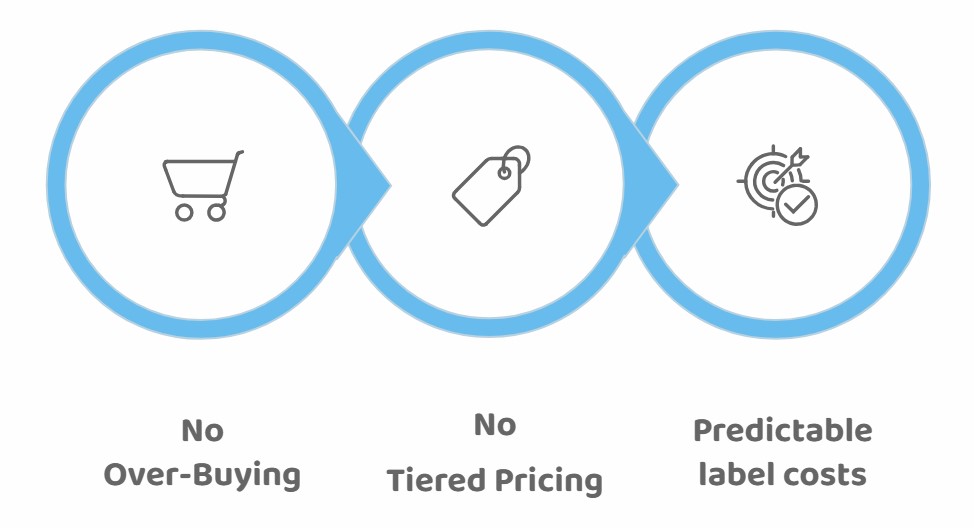
The shift from tiered to flat pricing is not just a cost improvement — it’s an operational freedom that compounds across every client relationship and every production decision you make. Also, it provides larger margin opportunity if you offer a tiered pricing model to your clietns.
Strategic Advantage: From Cost Center to Profit Driver
The most significant transformation LabelDrive enables is not in any single metric — it’s in how label procurement is repositioned within your business model. Under the legacy model, product labels are an unavoidable cost center: a source of delays, waste, administrative complexity, and unpredictable expenses. Under the LabelDrive model, offering “Labels-as-a-Service” to your clients becomes an agile, predictable, scalable, controlled, and potentially revenue-generating operational capability.
Operational Control
Full intra-department order visibility across all client accounts, all label SKUs, and all order statuses from a single platform. Proactive management replaces reactive firefighting. Production schedules hold. Client commitments are met.
- Centralized platform for all clients (& SKUs)
- Real-time order visibility and tracking
- Proactive delay prevention
- Scalable across >100+ client accounts
Revenue Opportunity: LabelDrive
LabelDrive creates a direct path to new revenue. By offering on-demand label services to your private label clients under your brand, you transform a procurement function into a billable service line — with LabelDrive’s infrastructure powering the fulfillment.
- White-label "Labels-as-a-Service" for your clients
- New revenue stream with minimal overhead
- Strengthen client retention and stickiness
- Differentiate your offering in a competitive market (help secure new clients)
This 5 point advantage — operational control + agility + speed + lower costs + revenue opportunity — is what elevates LabelDrive from a vendor swap to a strategic patnership and business decision.
You’re not just changing how you buy labels; you’re changing what label procurement means to your business and your clients.
Why This Model Scales With Your Business
One of the most compelling aspects of the LabelDrive model is that its advantages compound as your client roster grows. Under legacy procurement, scale creates complexity and friction: more clients mean more SKUs, more printer relationships, more MOQ negotiations, and more inventory to manage. Growth increases cost and administrative burden in roughly equal proportion to revenue. That’s a structural ceiling on profitability and is difficult to scale.
LabelDrive inverts this dynamic. Because the platform is centralized, adding a new client doesn’t add a new vendor relationship — it adds a new account within an existing, already-optimized system.
Because there are no MOQs and flat pricing, new client volumes can be accommodated immediately without procurement restructuring. Because pricing is flat, the economics of serving a five-SKU client and a five-hundred-SKU client are equally predictable and equally rational.

Scales Without Procurement Complexity
Each new client added to your roster operates within the same procurement model — no new vendor negotiations, no new pricing tiers, no new MOQ calculations. Just lower costs, less inventory risk, more agility, and less procurement time.

Unified Visibility Across All Accounts
Single-platform order management means you have intra-department order visbility for every client in real time — a capability that becomes more valuable as your client base expands. No more being in the dark on label shipments.
Strengthens Client Relationships
48-hour turnaround and precise & flexible ordering capability make you a more reliable manufacturing partner — reducing client churn and creating competitive differentiation that has nothing to do with price.
See the Model in Action — Schedule a 15-Minute Overview
The economics are clear. The case study is real. And the model is operational today for private label manufacturers and contract packagers looking to eliminate procurement waste, reduce costs, and build a more scalable, profitable business. A 15-minute conversation with the LabelDrive team is all it takes to understand exactly how this model applies to your specific operation, your client mix, and your current label procurement structure.
There’s no obligation, no complex sales process, and no minimum commitment. Just a straightforward conversation about whether 48-hour turnaround, no MOQs, and flat pricing at your best volume rate can change the economics and agility of your business — the way they already have for NutraPak and a growing list of contract manufacturers across the country.
What You'll Learn
- How flat pricing applies to your current client and SKU mix
- Estimated cost and waste reduction for your operation
- How LabelDrive PLUS creates new revenue
- The quick and easy the implementation timeline and onboarding process
Contact
Mark Pohlkamp
Think Different Print | LabelDrive
Schedule directly or reach out with questions. The 15-minute format respects your time and delivers a clear, specific picture of what LabelDrive means for your bottom line.
- Ready to replace waste and complexity with speed, agility, predictability, and profit?
Schedule your no commitment 15-minute overview here: LabelDrive Consultation — and see exactly what this model means for your operation.